
Strategy
Where Sustainability Meets Strategy
Reefonomics applies business logic to conservation, introducing accountability and a results-driven approach that supports corporate goals.
The Landscape
A Regulatory Shift
The regulatory landscape for biodiversity and nature-related disclosure is changing rapidly. Frameworks like the Taskforce on Nature-related Financial Disclosures (TNFD), the EU's Corporate Sustainability Reporting Directive (CSRD), and the Kunming-Montreal Global Biodiversity Framework are creating new expectations for corporate accountability.
There is now a competitive advantage associated with credible contributions to effective conservation at a meaningful scale. Companies that move early secure not just compliance, but differentiation.
TNFD
Nature-related risk and opportunity disclosure — voluntary, rapidly becoming expected.
CSRD / ESRS E4
EU mandatory biodiversity and ecosystem reporting for large companies.
Kunming-Montreal
Global commitment to protect 30% of land and ocean by 2030.
SBTN
Science-Based Targets for Nature — setting measurable biodiversity goals.
The Approach
Outcomes, Not Activities
The paradigm is shifting from method-driven to outcome-driven conservation reporting. Companies want to be seen doing something — but the question is increasingly whether that something actually works.
Method-driven metrics. Visible activities. Counts without context.
- Count trees planted, coral fragments transplanted
- Focus on visible outputs, not ecological change
- Unverified claims about biodiversity impact
- No independent scientific audit
- Often greenwashing in practice
Measured ecosystem health. Verified biodiversity outcomes. Data you can audit.
- Verified biodiversity improvements over time
- Measured ecosystem health across reef cells
- Science-led, multi-sensory monitoring
- Third-party auditable data
- 30 years of proven track record
For Partners
What Reefonomics Represents
Marketing Plug-In
A credible and meaningful marketing plug-in. Connect your brand to real conservation impact with verified stories, data, and imagery.
Sustainability Reporting
A robust underpinning for sustainability reporting. Verified ecological outcomes you can report with confidence under TNFD, CSRD, and evolving frameworks.
Long-Term Partnership
An opportunity for a long-term, impactful partnership. Not a one-off transaction, but a lasting commitment to measurable marine conservation.

Reporting Alignment
Mapped to the Major Reporting Frameworks
A Reefonomics partnership is designed to feed directly into the disclosures and global goals that increasingly govern corporate nature reporting. Click any framework to expand.
Mandatory
EU CSRD & ESRS
EU CSRD & ESRS
Feeds the EU Corporate Sustainability Reporting Directive's disclosure standards — mandatory for large EU and EU-adjacent companies.
- E4-2 Biodiversity policies — including sustainable oceans and seas practices.
- E4-3 Actions and resources for biodiversity, including Indigenous knowledge and nature-based solutions.
- E4-4 Targets aligned with the Kunming-Montreal GBF.
- E4-5 Impact metrics — ecosystem condition, species richness and abundance, habitat connectivity.
- S1 / S3 Workers and affected communities — positive impacts for value-chain workers and local communities.
- G1 Business conduct — management of supplier relationships with social and environmental criteria.
Voluntary
TNFD
TNFD
The Taskforce on Nature-related Financial Disclosures — four pillars, all directly supported.
- Governance (C) Human rights, Indigenous peoples and local community engagement.
- Strategy (A) Nature-related dependencies, impacts, risks and opportunities across short, medium and long time horizons.
- Strategy (B) Effect on business model, strategy and financial planning.
- Strategy (C) Processes for managing nature-related issues.
- Risk & Impact Management (B) Inputs, parameters and data sources for identifying nature-related risks.
- Metrics & Targets (A) Metrics used to assess and manage material nature-related risks and opportunities.
Global goal
UN SDGs
UN SDGs
Direct contribution to eight Sustainable Development Goals.
- SDG 1 No Poverty — long-term stable income from reef protection for coastal communities.
- SDG 4 Quality Education — vocational training; 450+ local staff; 160 former fishermen on scientific patrol.
- SDG 8 Decent Work — local employment in the environmental service sector.
- SDG 12 Responsible Consumption — sustainable management and reporting of marine resources.
- SDG 13 Climate Action — intact coral reefs mitigate climate impact and build coastal resilience.
- SDG 14 Life Below Water — directly delivers against 14.2, 14.4 and 14.5 through 60+ km of effective marine protection.
- SDG 16 Peace & Institutions — community-led patrols, transparent monitoring, village-level governance.
- SDG 17 Partnerships — mobilises private finance into effective conservation.
Global goal
Kunming-Montreal GBF
Kunming-Montreal GBF
The Global Biodiversity Framework — 2050 Goals and 2030 Targets.
- Goal A Protect and restore ecosystems; halt human-induced extinctions.
- Goal B Prosper with nature — ecosystem functions and services valued and maintained.
- Goal D Invest and collaborate — closing the biodiversity finance gap.
- Target 1 Participatory, biodiversity-inclusive spatial planning.
- Target 2 Restore 30% of degraded ecosystems.
- Target 3 Conserve 30% of coastal and marine areas by 2030 ("30×30").
- Target 5 Sustainable, legal and safe use of wild species.
- Target 8 Minimise impacts of climate change on biodiversity; nature-based solutions.
- Target 11 Restore and enhance nature's contributions to people.
- Target 15 Corporate biodiversity disclosure — the regulatory ancestor to TNFD/ESRS E4.
- Target 19 Mobilise $200B/year for biodiversity through innovative finance.
Voluntary
GRI
GRI
The Global Reporting Initiative's standards across biodiversity and local communities.
- GRI 101-1 Policies to halt and reverse biodiversity loss, informed by the GBF 2050 Goals and 2030 Targets.
- GRI 101-2 Management of biodiversity impacts — transformative conservation actions taken with third parties (NGOs, scientific institutions, local communities).
- GRI 413-1 Operations with local community engagement: impact assessments, ongoing monitoring, public disclosure, community-driven development programs.
Voluntary
UN Global Compact
UN Global Compact
Principles-based framework on human rights, labour, environment and anti-corruption.
- Principle 1 Support and respect human rights — Reefonomics delivers this through protecting the economic livelihood of coastal communities and the rights of local and Indigenous peoples.
- Principle 8 Undertake initiatives to promote greater environmental responsibility — supported by measurable, transparent reef protection and ecological reporting.
A detailed frameworks mapping is available on request — get in touch for a copy.
Looking Ahead
Scaling Protection
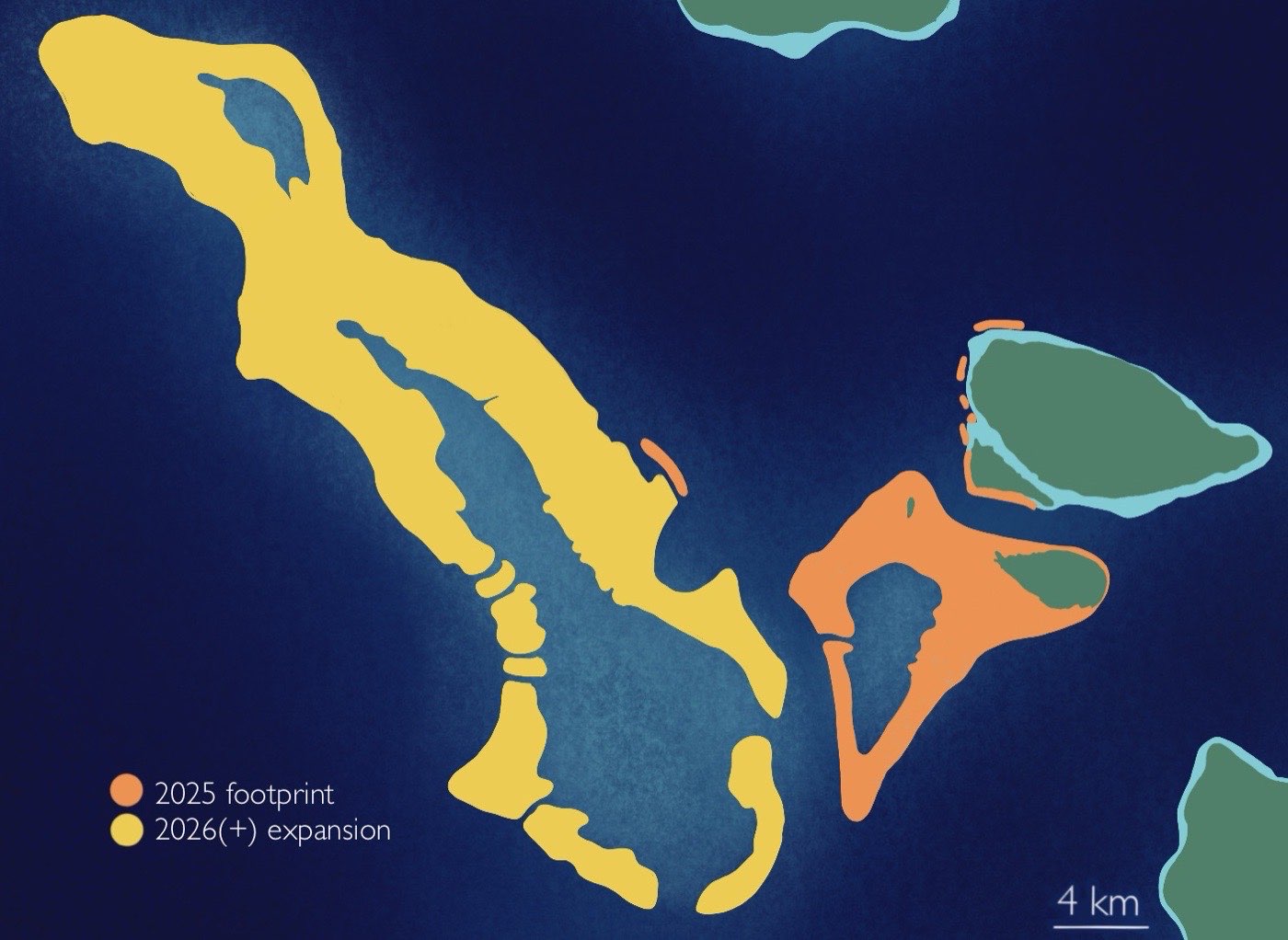
Reefonomics has already charted a course to the next stage of expansion: full protection of Karang Kaledupa atoll, targeting 185 km of protected reef. More reef protection means more income flowing to local communities, more livelihoods linked to healthy ecosystems, and the engagement of a broader network of local stewards.
A scalable, efficient, and community-rooted system for reef preservation — delivering real benefits to biodiversity, to coastal communities, and to the companies that help make it possible.
Ready to explore what partnership could look like?
We design bespoke engagements. Every partnership begins with a conversation.
julia@reefonomics.comExplore Partnerships