
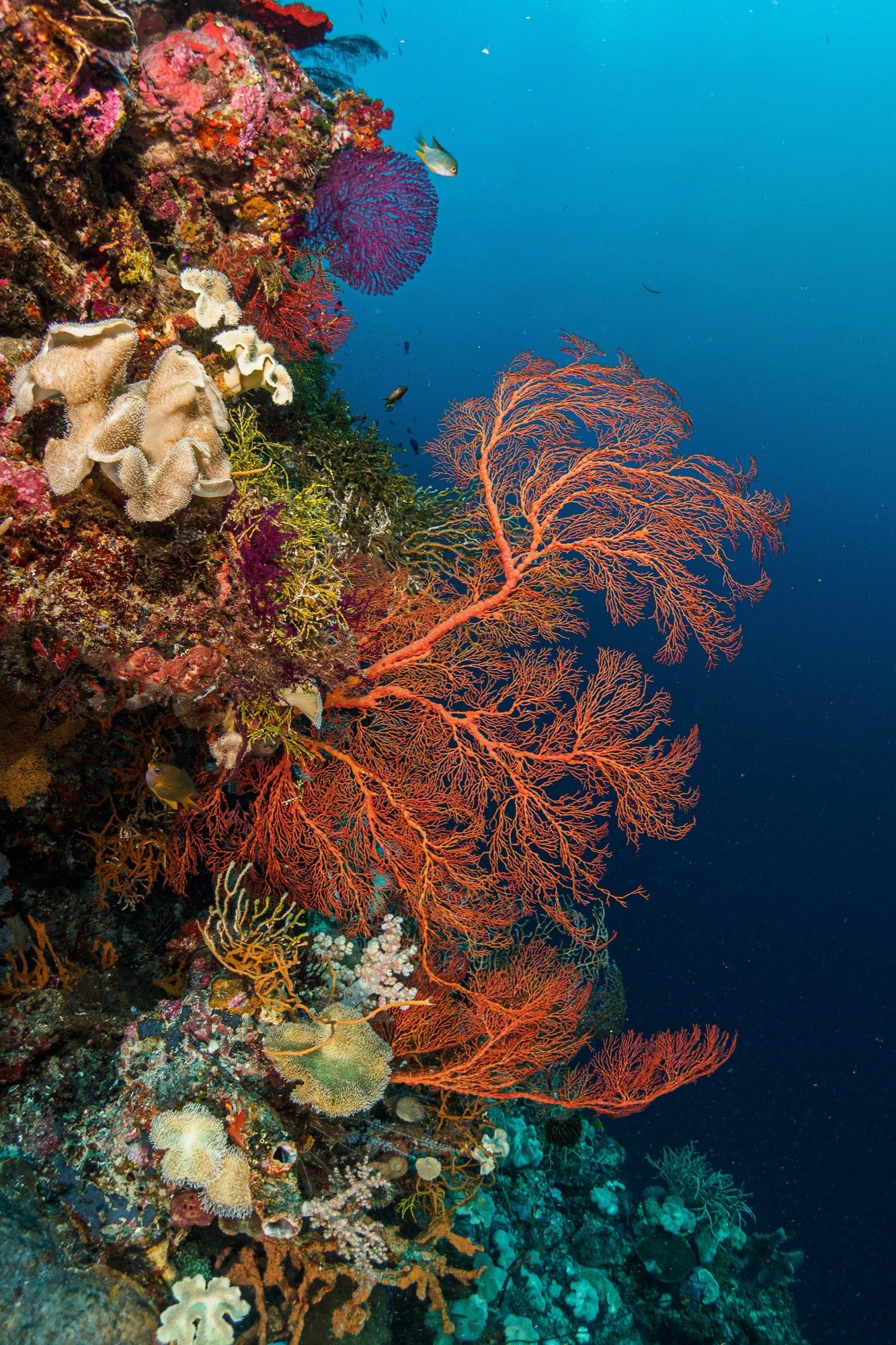
Most corporate conservation partnerships deliver one of two things: a certificate, or a line in a sustainability report. Reefonomics is built to deliver something different — a continuous, auditable connection to a specific piece of protected reef, and a toolkit that lets partners turn that connection into credible communication, reporting, and engagement.
Because every partnership is bespoke, there's no standard package. But there is a standard set of things partners consistently value. Here's what that looks like in practice.
A piece of the reef
Every partnership begins with the allocation of reef cells — hexagonal units of mapped, monitored reef inside the Wakatobi protection perimeter. Reef cells aren't symbolic; they're the same unit the monitoring programme uses for auditing and reporting. A partnership can be measured in reef cells the way a forest programme might be measured in hectares — except that every cell has a live data layer behind it.
Partners typically receive:
- A defined set of reef cells, visible in the Reef Hive 3D map
- Named monitoring events for those cells (reef scans, acoustic recordings, eDNA samples)
- The ability to track those cells' health trajectory over time
The monitoring data
Partners don't need to trust the conservation claim; they receive the underlying data. Reefonomics' four-pillar monitoring programme produces outputs across complementary modalities:
- Reef Scan: high-resolution photo transects, classified by machine learning with over 90% accuracy across 28 habitat types
- Reef Song: acoustic recordings with identified fish choruses, dawn and dusk aggregations, and diversity indicators
- eDNA: environmental DNA samples that catalogue species present at a site, including cryptic and rare taxa
- Ocean Weather: real-time chemical and physical seawater monitoring — pH, dissolved oxygen, CO₂
Results are uploaded to a partner dashboard and mirrored in Reef Hive. Independent scientific peer review is built into the programme cycle.
The reporting
A periodic report — typically annual, often quarterly — is where the monitoring data becomes a usable artefact for sustainability teams. Reports include:
- Year-on-year comparison of habitat health inside the partner's allocated cells
- Species-level findings (including notable rare or threatened species detected)
- Community and operational updates — who's patrolling, what was expanded, what was learned
- Climate events and resilience indicators
- Narrative connecting ecological outcomes to the partner's own sustainability framework (TNFD, CSRD, ESRS E4)
The Below the Surface Report is Reefonomics' flagship annual publication — and partners receive a bespoke version scoped to their allocation.
The imagery and storytelling
Conservation claims are strengthened by the ability to show, not just tell. Partnerships include rights and assets for brand use:
- High-resolution photography from partner-allocated areas
- Short video content from the resort and conservation operation
- Approved narrative content for use in reports, campaigns, and communications
- Stories from the 160 former fishermen who patrol the reef — the human face of the programme
Partners don't just fund something abstract. They have a visual, narrative, and data-backed connection to a specific ecosystem they are demonstrably helping to protect.
The optional layers
Bespoke means bespoke. Depending on the partner's goals, additional components may include:
- Site visits — staff, executive, or client trips to Wakatobi with structured reef and conservation programmes
- FinLog activations — sponsoring citizen science campaigns through the FinLog app, generating observation data and audience engagement
- Co-branded storytelling — short films, written features, or event content
- Scientific co-authorship — named sponsorship of peer-reviewed outputs where appropriate
- Extension partnerships — funding the expansion of protection to new reef cells, with attribution
What partners don't get
Reefonomics isn't a carbon offset scheme. Partners don't receive tradeable credits. They don't receive claims about emissions sequestered. And we don't sell generic certificates that could be issued to any buyer.
What they get is more specific, more defensible, and — for the kind of organisation that takes nature reporting seriously — more useful.
How to start
Every partnership begins the same way: a conversation. Tell us about your organisation's sustainability goals, your reporting framework, and what you want to be able to say about your impact. We'll explore together how Reefonomics could fit, and what a bespoke engagement might look like.
julia@reefonomics.com — we typically respond within 48 hours.