
For most of corporate sustainability's short history, "nature" sat outside the reporting perimeter. Carbon was quantifiable. Ecosystems weren't. Biodiversity was a CSR story, not a financial disclosure.
That changed quickly. A cluster of frameworks and regulations — TNFD, CSRD, ESRS E4, SBTN, the Kunming-Montreal Global Biodiversity Framework — has moved nature from the back of the annual report to somewhere much closer to the audited accounts. For companies now preparing their first round of nature-related disclosures, the message is consistent across regulators: tell us what you depend on, what you impact, and what you're doing about it. Tell us with data.
What's actually changing
The alphabet of new nature standards can be disorienting. Four frames matter most:
- TNFD — the Taskforce on Nature-related Financial Disclosures. A voluntary framework (for now), mirroring TCFD's approach to climate. Companies identify nature-related risks, dependencies, impacts, and opportunities across their operations and value chain.
- CSRD / ESRS E4 — the EU's Corporate Sustainability Reporting Directive, with the Biodiversity and Ecosystems standard (ESRS E4). Mandatory for large EU and EU-adjacent companies. Requires material biodiversity impacts to be disclosed — including positive contributions.
- SBTN — Science-Based Targets for Nature. The framework for setting measurable, science-backed targets on freshwater, land, ocean, and biodiversity.
- Kunming-Montreal — the global framework, with the headline commitment to protect 30% of land and ocean by 2030.
The frameworks differ in scope and enforcement. What they share is a shift in burden of proof. Claims about biodiversity impact now need to be measurable, independently verifiable, and connected to real ecological outcomes.
Why outcomes, not activities
This is where many corporate nature programmes risk falling short. The last decade's playbook — plant trees, plant coral, sponsor a habitat — generated activity, but rarely generated evidence. New regulation asks the harder question: did the ecosystem get healthier?
Activity-based reporting describes what a company did. Outcome-based reporting describes what changed in the ecosystem as a result. Only one is increasingly acceptable.
Coral planting is the canonical cautionary tale. Tens of millions of dollars have gone into coral restoration programmes globally, often with poor survivorship and no net benefit at the reef scale. The optics are strong; the ecological outcomes are typically weak. As disclosure frameworks mature, activity metrics (fragments planted, hectares restored) will increasingly need to be paired with — or replaced by — outcome metrics (species present, habitat structure, ecosystem function).
The new burden of proof
For companies preparing for ESRS E4 or a TNFD disclosure, three questions are becoming essential to every nature programme:
- Is it measurable? Can you quantify the ecological state of the area your programme affects, and show how it changes over time?
- Is it verifiable? Does someone independent of your organisation audit the monitoring, or could you reproduce the measurement?
- Is it additional? Would the outcome have occurred anyway, or is your contribution the reason it's happening?
A defensible nature programme answers all three. A "nice to have" programme typically answers none.
What reef conservation looks like through this lens
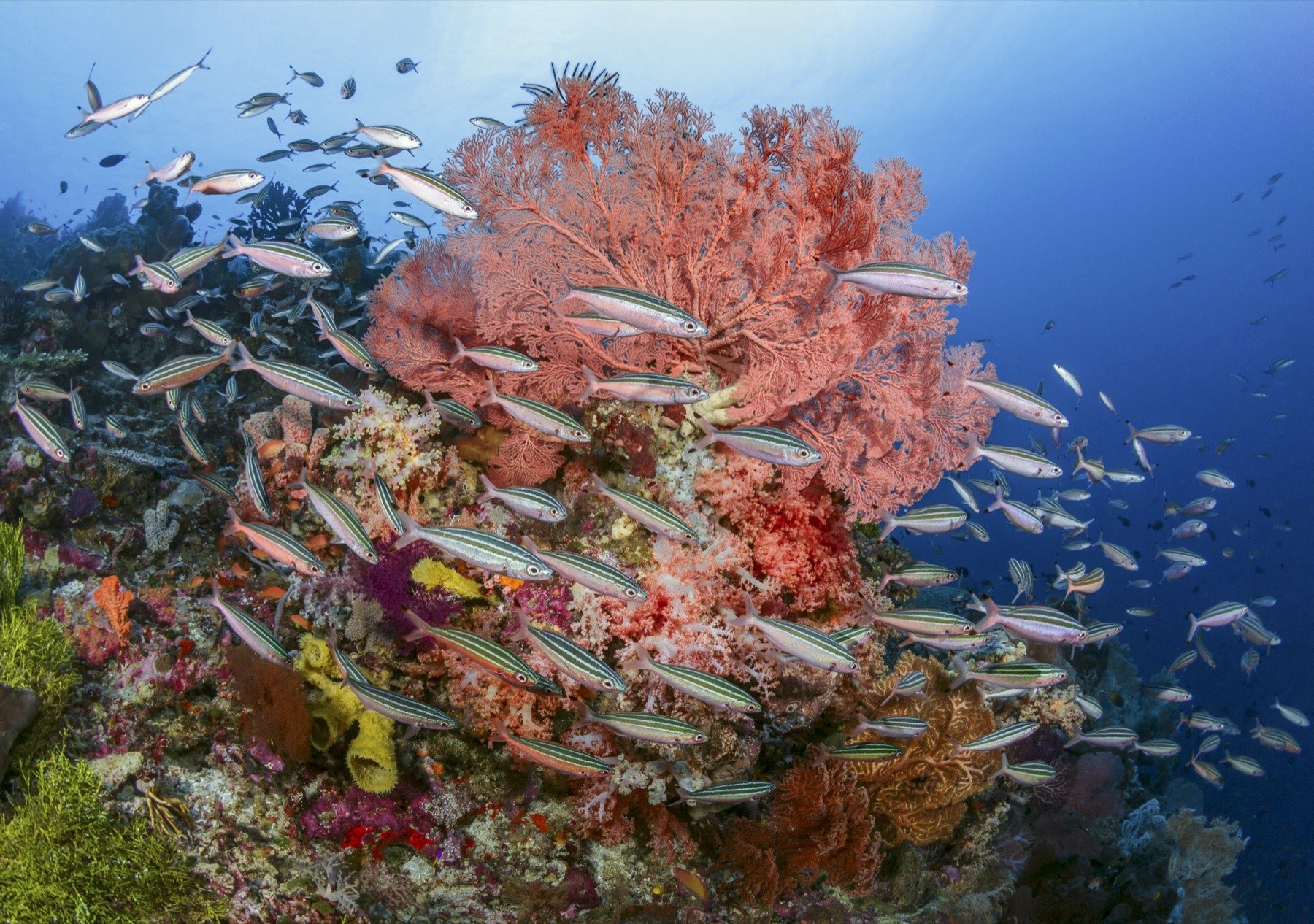
Reef ecosystems are among the most measurable marine systems we have. Photo transects can be AI-classified for habitat structure. Acoustics reveal fish diversity. Environmental DNA catalogues species presence — including cryptic and threatened ones. Chemistry sensors track metabolic health.
The Wakatobi monitoring programme produces this evidence at scale — 373 reef cells surveyed, 78.3% healthy habitat inside the protected area versus 56.4% outside, 284 taxa identified via eDNA, seven threatened coral species detected inside protection and only two outside. That's outcome data, not activity data. That's what a disclosure framework is looking for.
How Reefonomics maps to the frameworks
This isn't theoretical. Reefonomics has explicitly mapped its activities to each of the major frameworks. A partnership can feed directly into a partner's reporting across the following:
- UN SDGs: direct contribution to 1 (No Poverty), 4 (Quality Education), 8 (Decent Work), 12 (Responsible Consumption), 13 (Climate Action), 14 (Life Below Water), 16 (Peace, Justice & Strong Institutions), and 17 (Partnerships for the Goals). SDG 14 is especially well served — the programme delivers against 14.2, 14.4 and 14.5 directly, through effective protection, enforcement, and community-led management of 60+ km of reef.
- Kunming-Montreal Global Biodiversity Framework: alignment with Goals A (Protect and Restore), B (Prosper with Nature) and D (Invest and Collaborate), and with Targets 1, 2, 3, 5, 8, 11, 15, and 19 — including the headline 30×30 target for marine protection and Target 15's corporate biodiversity disclosure requirements.
- EU CSRD / ESRS: direct relevance to E4 (Biodiversity and Ecosystems), including E4-2 policies on sustainable oceans, E4-3 biodiversity actions, E4-4 ecosystem-related targets aligned with the GBF, and E4-5 impact metrics. Also feeds into S1 (workers), S3 (affected communities) and G1 (business conduct).
- GRI: supports 101.1 (policies to halt and reverse biodiversity loss), 101.2 (management of biodiversity impacts, including transformative conservation actions with third parties), and 413.1 (local community engagement, assessments, development programs).
- TNFD: provides material for all four pillars — Governance (C: human rights, Indigenous peoples, local communities), Strategy (A/B/C: dependencies, impacts, risks, opportunities across time horizons), Risk & Impact Management (B), and Metrics & Targets (A).
- UN Global Compact: Principles 1 (human rights) and 8 (environmental responsibility).
A partnership that's credible at the reef is also a partnership that's legible inside a corporate disclosure. That's the design intent.
Where this goes
Three shifts are already visible:
- Integration with financial statements. Biodiversity is moving from sustainability annex to integrated reporting, and eventually to the audit perimeter.
- Material impact tests. "Doing something good somewhere" won't pass double-materiality tests. Companies need to show that their contribution is material to the ecosystem, not just to their communications.
- Competitive advantage. Companies with credible, science-backed conservation partnerships — ones that predate the regulations and survive independent scrutiny — will find themselves advantaged in reporting, in marketing, and in stakeholder trust.
What this means for companies now
There is now a real competitive advantage associated with credible contributions to effective conservation at meaningful scale. The old currency — visibility of activity — is depreciating. The new currency is evidence of outcome.
For companies planning their first TNFD disclosure, their first CSRD-compliant report, or their first SBTN biodiversity target, the question becomes: which of our nature-related activities would survive an audit? The answer will shape the next decade of corporate environmental strategy.
Reefonomics was built for this moment — to translate 30 years of proven reef protection into data that meets the rising burden of proof. If you're thinking through your nature disclosure and want to explore how a partnership could fit, we'd love to hear from you: julia@reefonomics.com.